

The Texas-based automaker’s design director shares how the carbon-fiber model references the aircraft, and why it has no screens.
Aviation has long inspired many of the world’s finest cars, its influence evident from classics such as the concours-winning 1935 Voisin C25 Aerodyne to the recent Czinger 21C hypercar. The latter drew inspiration from the SR-71 “Blackbird” spy plane, and that groundbreaking aircraft has now inspired another marque’s model, developed for the rarefied world of cutting-edge engineering and design: the Hennessey Blackbird.
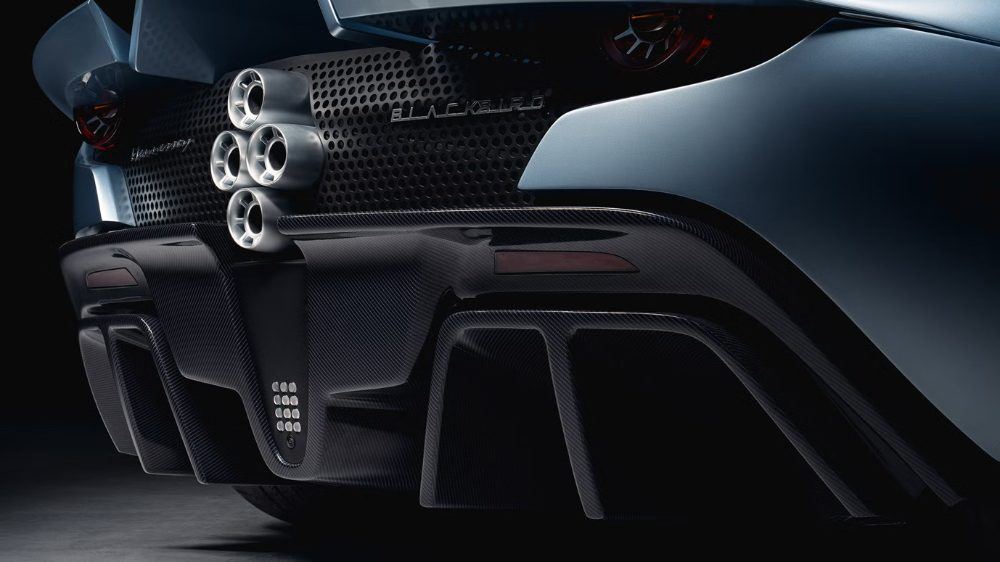
John Hennessey, founder and CEO of Hennessey Special Vehicles, has spent 35 years pushing the limits of performance. That pursuit produced the 2020 Venom F5, targeting a top speed of more than 300 mph, followed by the 2,031 hp Venom F5 Evolution and, earlier this year, the manual Venom F5-M. Today, Hennessey unveiled its second clean-sheet creation, the Blackbird, which pays tribute to the SR-71 through numerous aesthetic and functional details while offering driving comfort absent from its predecessors.

“It’s actually quite an unexpected follow-up to the [Venom] F5, which, in some ways, makes it the best follow-up to the F5,” Nathan Malinick, Hennessey’s design director, tells Robb Report. According to Malinick, the Blackbird is a direct response to customer demand. “If anyone is really paying attention to the automotive world right now, there is an intense, burning desire to return to that material connection, that analog sensibility,” he says. “That’s what people want, and it just so happens that’s what we want too… what you end up creating is more a passion project than a cut-and-dry business case.”
Rather than chasing headline-grabbing specifications, the Hennessey team pursued a different goal with the Blackbird. “The target was from John,” Malinick explains. “He said people need to be able to go 800 miles in a day and not be crushed after that experience, and you have to be able to pack whatever you need for that weeklong journey.”

The result is a car powered by a new 6.2-liter engine developed with Ilmor Engineering, the company behind the Venom F5’s power plant. “It’s a naturally aspirated V-8 revving to 9,000 rpm, and it will be the most powerful road-going homologated V-8 ever produced,” says Malinick. Final figures are still pending, but output is expected to range from 800 hp to 900 hp, driving the rear wheels through a six-speed manual transmission. The setup should propel the Blackbird from zero to 60 mph in 2.5 seconds and on to a top speed of 220 mph.
True to its grand touring purpose, the Blackbird has room in the front for two carry-on bags. Malinick adds that beneath the rear quarter panel there is space for custom luggage, while the cabin can accommodate two more duffel bags behind the seats.
The carbon-fiber Blackbird references its aeronautical namesake mainly through its exterior styling, especially the distinctive line running along its flanks. “This is called the chine line. This is directly from the plane,” says Malinick. “That is really one of the only creases on the whole car. Everything else is flowing, sweeping surfaces, ensuring the car remains timeless. But this one hard line keeps the car in tension…”
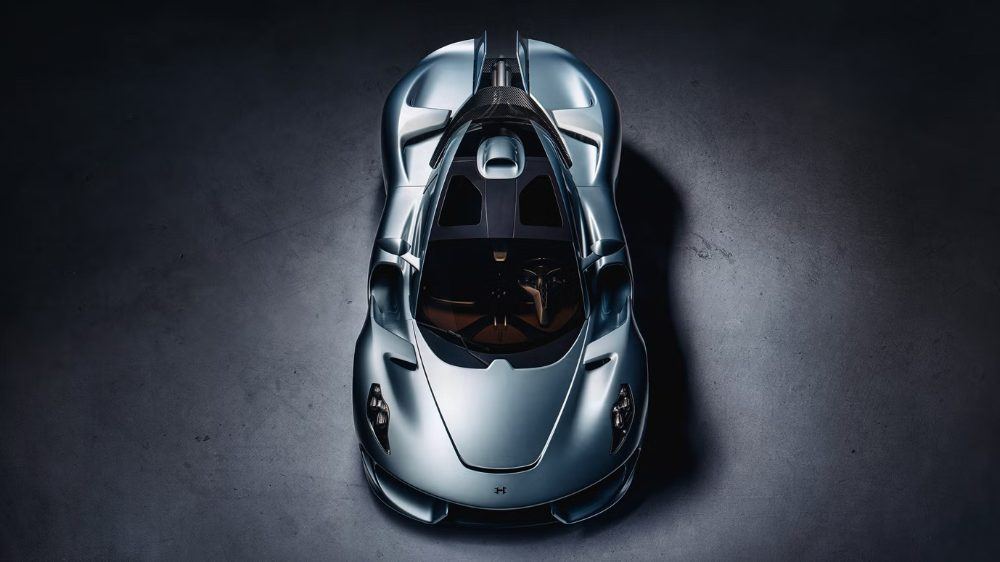
Even more directly inspired by the SR-71 are the active vertical stabilizers at the rear. They deploy automatically at 71 mph and sit at a 71-degree angle. Another Space Age reference is the quad exhaust arranged in a diamond pattern, borrowed from the Bell X-1, the aircraft that first broke the sound barrier with legendary pilot Chuck Yeager at the controls. The diamond motif also appears throughout the Blackbird, including the four cupholders.
The Blackbird’s cockpit, accessed through gullwing doors, best reflects its analog philosophy, with no display screens. Instead, the central focus is the tachometer behind the steering wheel, complemented by a gated shifter within the skeletonized center console.
Apple CarPlay, Android Auto and the sound system are all controlled through the driver’s smartphone. “When I go home, if I want to play music throughout the house, it’s all done through my phone… just connect to Bluetooth and away you go,” says Malinick. “That’s the exact same concept here. And who knows how phones will look 50 years from now? We even thought about that. We just want this interior to last.”
What also won’t last long is the production run. The Blackbird is expected to enter production in 2028 or 2029, with just 71 examples planned and a starting price of $2.5 million. Malinick believes they will all be spoken for during Monterey Car Week, when the prototype debuts on August 14 at The Quail, A Motorsports Gathering.
“John has made it clear that this car is not just the next chapter, but really a new book for Hennessey,” Malinick says. “With this car, you’re starting to get a clear picture of what Hennessey DNA will be moving forward.”